Memory Care Marketing: The Complete Guide to Reaching Families and Building Trust
Memory care has the highest CPL and longest emotional journey. This guide covers compliance, family-focused messaging, content strategy, and conversion tactics.
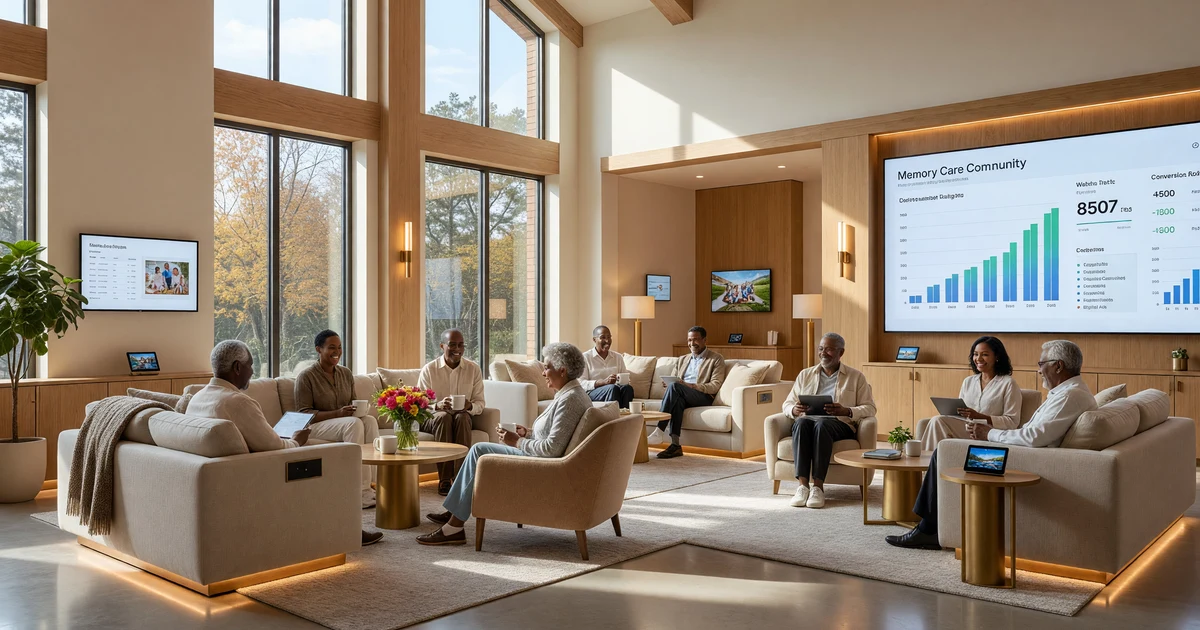
Memory care marketing is fundamentally different from marketing independent living, assisted living, or any other senior care type, because the family making the decision is navigating the most emotionally complex healthcare choice they have ever faced. The adult child researching memory care for a parent with Alzheimer’s or dementia is frightened, grieving, often guilt-ridden, and overwhelmed by clinical terminology and financial complexity. Marketing that ignores this emotional reality fails. Marketing that exploits it is unethical. The communities that succeed are the ones that meet families with genuine empathy, transparent information, and practical guidance delivered at the right time in the right way.
Memory care also carries the highest marketing costs in senior living: cost per lead ranges from $80 to $200, referral fees run $7,000 to $12,000 per move-in, and sales cycles can stretch from 14 days (crisis placement) to 120 days (early-stage, planned transition). The financial stakes demand that every marketing dollar works harder and every family touchpoint builds trust rather than eroding it.
This guide covers the full memory care marketing landscape: the family decision journey, compliance considerations, content that builds trust, channel strategy, conversion optimization, and the metrics that matter.
The Memory Care Decision Journey
The decision to place a loved one in memory care follows a different emotional arc than other care types. Understanding this journey is the foundation for every marketing decision.
Stage 1: Denial and Early Research (6-18 months before placement)
Most families begin researching memory care long before they are ready to admit they need it. The adult child notices concerning signs: repeated questions, forgotten medications, a kitchen fire, a wandering episode. They search “is my parent getting dementia” or “early signs of Alzheimer’s” before they ever search “memory care community.”
What families need at this stage: Educational content that validates what they are observing without being alarmist. Guides on “what to watch for,” “when to talk to a doctor,” and “understanding the difference between normal aging and dementia.” This content builds trust with families 6-18 months before they become prospects.
Marketing approach: Blog posts, family guides, and video content that addresses the emotional experience of watching a parent decline cognitively. This content targets informational keywords like “early signs of dementia” and “when does a parent need memory care.” It does not sell. It serves. The families who find this content and bookmark it are the families who remember your community when the need becomes urgent.
Stage 2: Crisis and Urgent Research (1-4 weeks before placement)
A health event or safety incident, such as a fall, a wandering episode, a hospitalization, or the primary caregiver burning out, accelerates the timeline. The family shifts from “we might need this someday” to “we need this now.” Searches become specific: “memory care near [city],” “Alzheimer’s community cost,” “best memory care in [state].”
What families need at this stage: Specific, actionable information. Pricing, availability, admission timeline, what to expect on move-in day, and what the first week looks like. They do not have time for vague marketing language. They need answers.
Marketing approach: Community pages with specific data: number of memory care units, staff-to-resident ratios in the memory care wing, pricing ranges, accepted payment types (private pay, long-term care insurance, Medicaid where applicable), and admission process timeline. Speed of response matters enormously at this stage. Families in crisis choose the first community that answers their questions clearly.
Stage 3: Evaluation and Comparison (1-3 months)
Families who are not in crisis mode enter a methodical evaluation phase. They tour 3-5 communities, compare pricing, read reviews, ask questions about programming, and involve multiple family members in the decision. This stage is emotionally exhausting because every tour forces the family to confront the reality of the parent’s condition.
What families need at this stage: Differentiation. Every memory care community claims to offer compassionate, person-centered care. Families need to understand what makes your community specifically different. Is it your programming model? Your staffing ratios? Your approach to behavioral management? Your family support services?
Marketing approach: Tour experiences that are personalized based on the family’s specific situation (care type discussed in AI qualification, primary concerns identified during initial contact, specific questions the family has asked). Post-tour follow-up that references specific details from the tour conversation rather than sending generic brochures. Testimonials and reviews from families in similar situations.
Stage 4: Decision and Transition (1-2 weeks)
The decision is made. The family has chosen a community. The transition period is often the most stressful time of the entire journey. The parent may resist. Other family members may disagree. The adult child feels guilt, relief, and fear simultaneously.
What families need at this stage: Reassurance and practical support. Move-in guides, “what to bring” lists, expectations for the first week, how the community handles the adjustment period, and ongoing family communication plans.
Marketing approach: Transition support materials (guides, checklists, family orientation videos) that demonstrate the community has done this before and knows how to support both the resident and the family through the transition. This content also serves as post-sale referral fuel: families who feel supported tell other families.
Compliance Considerations in Memory Care Marketing
Memory care marketing operates in a more regulated environment than general senior living marketing. Understanding the boundaries protects your community legally and ethically.
What You Can and Cannot Claim
You can describe your programming, staffing, physical environment, and approach to care. You can share resident and family testimonials (with written consent). You can publish general outcome data (participation rates, family satisfaction scores, fall rates) when the data is accurate and documented.
You cannot claim to cure, reverse, or halt Alzheimer’s disease or other dementias. You cannot guarantee specific clinical outcomes. You cannot misrepresent your staff’s credentials or your community’s licensing level. Any claims about health outcomes must be substantiated by documented evidence.
Be careful with language that implies clinical services you do not provide. If your community offers “cognitive stimulation” programming (which is a structured activity), do not describe it in terms that suggest medical treatment. If you partner with healthcare providers for therapy services, be clear about the scope of that partnership.
State-Specific Regulations
Memory care licensing and marketing regulations vary by state. Some states require specific disclosures about the level of care provided and the staff’s training. Others regulate use of terms like “memory care” or “Alzheimer’s care” in marketing materials. Review your state’s requirements with counsel before launching campaigns, and keep disclosures current as regulations change.
HIPAA and Testimonial Consent
Any marketing that uses resident stories, photos, or health-related information requires HIPAA-compliant authorization. This includes:
- Written consent from the resident (if they have capacity) or their legal representative
- Specific authorization for the medium (print, website, social media) and duration
- Clear documentation that consent was freely given and can be revoked
Family testimonials that discuss their own experience (rather than the resident’s health information) have more flexibility but still benefit from written consent to avoid disputes.
Content That Builds Trust
Memory care content strategy centers on one principle: families trust communities that educate them, not communities that sell to them. Here are the content types that build trust at each stage of the journey.
Educational Guides (Top of Funnel)
- “Understanding the Stages of Alzheimer’s: What Families Should Expect”
- “When Is It Time for Memory Care? 10 Signs Families Often Miss”
- “The Difference Between Memory Care and Assisted Living: A Family Guide”
- “How to Talk to Your Parent About Memory Care”
- “Paying for Memory Care: Insurance, Medicaid, and Financial Planning Options”
These guides target families 6-18 months before placement. They build brand awareness, capture email addresses (if offered as downloadable guides), and establish your community as a trustworthy resource.
Comparison and Decision Content (Middle of Funnel)
- “What to Look for When Touring a Memory Care Community” (checklist format)
- “Questions to Ask During a Memory Care Tour”
- “How to Compare Memory Care Costs: What Is Included and What Is Not”
- “[City] Memory Care Options: A Family Comparison Guide”
This content targets families in the evaluation phase. It helps them make better decisions, which positions your community as confident enough to help families evaluate even if they ultimately choose a competitor. That confidence builds trust.
Community-Specific Content (Bottom of Funnel)
- “Our Approach to Memory Care: [Community Philosophy]”
- “A Day in the Life of a Memory Care Resident at [Community Name]”
- “Meet Our Memory Care Team: [Staff Profiles with Credentials]”
- “Family Support Services: How We Keep Families Connected”
- “What Families Say: Stories from Our Memory Care Community” (testimonials)
This content is for families who have toured or are actively comparing your community with competitors. It reinforces what they saw and heard during the tour with deeper detail.
FAQ Content (AI Search Optimization)
Memory care FAQ content is particularly valuable for AI search visibility because families ask specific questions that AI engines answer directly. Build FAQ sections targeting:
- “How much does memory care cost in [city]?”
- “What is the difference between memory care and assisted living?”
- “Does Medicare cover memory care?”
- “What activities do memory care communities offer?”
- “How do memory care communities handle behavioral challenges?”
- “Can couples live together in memory care if only one has dementia?”
Each answer should be 2-4 sentences with specific, citable data. This is the content that AI search engines extract and cite when families ask these questions in ChatGPT or Perplexity.
Channel Strategy for Memory Care
Organic Search (Highest Priority)
Organic search delivers the lowest cost per lead and highest-quality prospects for memory care. Families researching memory care conduct extensive online research, and communities that appear consistently across informational and commercial queries build cumulative trust.
Priority keywords:
- “memory care [city/state]” and “Alzheimer’s care [city/state]” (commercial intent)
- “memory care cost [city/state]” (high intent)
- “when does a parent need memory care” (informational, early-stage)
- “best memory care near me” (high intent, AI search target)
Paid Search (Supplement, Not Primary)
Google Ads for memory care keywords are expensive ($80-$200 CPL) but effective for capturing families in crisis mode who are ready to tour within days. Target:
- “[City] memory care” and “[City] Alzheimer’s care” keywords
- “Memory care near me” and “dementia care near me”
- Competitor brand terms (with appropriate landing pages)
Keep paid search to 25-35% of the memory care marketing budget. Higher allocation indicates over-reliance on a channel with rising costs and declining click-through rates.
Professional Referrals (Highest Conversion)
Neurologists, geriatricians, primary care physicians, hospital discharge planners, and elder care attorneys are the highest-converting referral sources for memory care. These professionals interact with families at moments of clinical diagnosis and crisis, when urgency is highest.
Build relationships through:
- Regular in-person visits to physician offices and hospital social work departments
- CME or professional education events hosted at your community
- Care coordination protocols that make it easy for physicians to refer
- Outcome data sharing (with appropriate privacy protections) that demonstrates your community’s clinical results
Content Marketing and Social Media
Memory care content performs best on platforms where families research and share experiences. Facebook remains the primary social platform for adult children in the 45-65 age range who are making care decisions. LinkedIn is relevant for professional referral relationship building.
Content types that perform well:
- Short-form video showing real community programming (with consent)
- Family testimonial stories (written and video)
- Educational graphics explaining care stages, costs, and decision frameworks
- Live or recorded Q&A sessions with clinical staff addressing family questions
Email Nurture
Memory care families have the longest nurture requirement of any care type. A family that downloads an educational guide may not be ready for placement for 12-18 months. Email nurture sequences must be calibrated for this timeline:
- Monthly educational content (not sales pitches)
- Seasonal programming highlights
- Quarterly cost updates relevant to their market
- Personal outreach from care counselors at 3-month intervals
- Clear, easy pathways to schedule a tour when the family is ready
The key is patience. Memory care email should feel like a resource, not a sales funnel. Families will reach out when the need becomes urgent, and they will reach out to the community that has been consistently helpful, not the one that sent the most aggressive follow-up.
Conversion Optimization for Memory Care
The Tour Experience
Memory care tours are emotionally charged. The family is walking through a space that represents a major life change for their parent and for themselves. Tours that focus on features (floor plans, dining rooms, amenity lists) miss the emotional core of the decision.
Effective memory care tours:
- Begin by listening to the family’s story. What is happening with their loved one? What are their biggest fears? What does a good day look like right now?
- Address the guilt directly. Families choosing memory care feel guilty. Acknowledge that this is one of the hardest decisions they will make, and that choosing specialized care is an act of love, not abandonment.
- Show programming in action, not just described. Let the family observe a cognitive stimulation session, a music therapy group, or a reminiscence activity. Seeing residents engaged and cared for is more powerful than any brochure.
- Introduce specific staff. “This is Sarah, who has been working in memory care for 12 years and will be part of your mother’s care team” creates a personal connection that “we have trained staff” never achieves.
- End with next steps, not a hard close. “Would it be helpful if I sent you our family transition guide and checked in next week?” is more effective than “when would you like to schedule a move-in date?”
Post-Tour Follow-Up
Post-tour follow-up is the largest conversion gap in senior living, and it is even more pronounced in memory care because of the longer decision cycle.
Build a 90-day follow-up sequence for memory care tours:
- Day 1: Personal email referencing specific tour conversation details
- Day 3: Family transition guide or “what to expect” resource
- Day 7: Phone call from the care counselor (not a generic sales rep)
- Day 14: Invitation to a family support group or educational event
- Day 30: Community update with recent programming highlights and resident stories
- Day 60: Personal check-in: “How are things going? Has anything changed?”
- Day 90: Gentle re-engagement with updated pricing and availability
Each touchpoint should reference information gathered during the tour and AI qualification. Generic follow-up demonstrates that you do not remember or care about the family’s specific situation.
The Financial Case for Memory Care Marketing Investment
Memory care carries the highest referral fees in senior living ($7,000-$12,000 per move-in through agencies), but it also generates the highest revenue per resident ($6,000-$10,000 per month). The lifetime value of a memory care resident is substantial:
| Metric | Calculation |
|---|---|
| Average monthly rate | $7,500 |
| Average length of stay | 18-24 months |
| Lifetime revenue per resident | $135,000-$180,000 |
| Cost per move-in (owned channels) | $3,500-$6,000 |
| Cost per move-in (referral agency) | $7,000-$12,000 |
| Marketing ROI (owned channels) | 22:1 to 51:1 |
| Marketing ROI (referral agency) | 11:1 to 25:1 |
The ROI gap between owned-channel and referral-agency acquisition is larger in memory care than in any other care type. This makes memory care the highest-priority care level for building owned marketing channels and reducing referral agency dependency.
I want to see how USR Engage reduces my memory care cost per move-in
Frequently Asked Questions
What is the average cost per lead for memory care marketing?
Memory care cost per lead ranges from $80 to $200 for owned-channel leads (organic search, paid search, content, social media) in 2026. This is the highest CPL of any senior living care type, driven by the emotional complexity of the search, competition for memory care keywords, and the longer research phase before families are ready to tour.
Why is memory care marketing different from assisted living marketing?
Memory care marketing differs in three critical ways: the emotional intensity is significantly higher (families are grieving a cognitive loss), the decision involves more family members (typically 2-4 adult children plus potentially a spouse), and the compliance environment is more restrictive (health claims, HIPAA, state-specific memory care licensing regulations). Marketing that works for assisted living often fails for memory care because it does not address the emotional journey adequately.
How long is the memory care sales cycle?
Memory care sales cycles range from 14 days (crisis placement after a hospitalization, fall, or safety incident) to 120 days (early-stage dementia, planned transition). The average is approximately 45-75 days. Crisis placements require immediate availability and rapid admission processes. Planned transitions require sustained nurture over 3-4 months.
What is the most effective marketing channel for memory care?
Professional referrals (neurologists, geriatricians, discharge planners, elder care attorneys) deliver the highest conversion rates (35-45% inquiry-to-tour, 38-45% tour-to-move-in). Organic search delivers the lowest cost per move-in ($1,200-$2,800). The most effective strategy combines both with systematic content marketing and AI search optimization. Referral agencies deliver fast results but at the highest cost ($7,000-$12,000 per move-in).
How should memory care communities handle online reviews?
Encourage families to leave specific reviews mentioning programs, staff interactions, and care experiences. Provide prompts like “Would you share your experience with our music therapy program?” rather than generic review requests. Respond to every review, including negative ones, professionally and with specific context. Reviews with experience keywords (program names, staff roles, specific amenities) are significantly more valuable for AI search visibility than generic positive reviews.
Do I need separate marketing for memory care versus my other care levels?
Yes. Memory care requires dedicated community pages, separate keyword targeting, distinct content, and a different messaging tone than independent or assisted living. Families searching for memory care are in a different emotional state, ask different questions, and evaluate communities on different criteria. Communities that treat memory care marketing as a subsection of their general marketing consistently underperform those with dedicated memory care marketing programs.
What compliance risks should I watch for in memory care marketing?
The primary compliance risks are: claiming to cure or reverse dementia or Alzheimer’s disease, misrepresenting staff credentials or licensing levels, using resident photos or health information without HIPAA-compliant authorization, and making outcome claims that are not supported by documented data. Review all memory care marketing materials with legal counsel familiar with your state’s licensing regulations.
Related Resources

![Senior Living Cost Per Lead: 2026 Benchmarks [Data]](/images/blog/senior-living-cost-per-lead-benchmarks.webp)
Ready to Transform Your Lead Management?
USR Engage's AI agents qualify leads 24/7, so your team can focus on what matters most -- converting prospects into residents.